

Jedify raises $24M to assist corporations arm AI brokers with context on their enterprise
AI distributors promote their enterprise merchandise as in the event that they’re turnkey options, however the chances are high low that AI brokers will hit the bottom working instantly. Until you place within the effort to coach a mannequin on the specifics of your enterprise, it’s unlikely to know how your organization, for instance, defines income or is aware of who’s allowed to see which file. That’s a part of the rationale why we’re seeing AI corporations deploying engineers to assist combine their AI merchandise into clients’ methods.
New York-based startup Jedify is attacking this very hole. The corporate says its platform connects to enterprises’ information sources by way of APIs to construct a “context graph” about their enterprise that AI brokers can use to work higher. These sources might be databases, information warehouses and lakes, SaaS apps, or BI instruments, in addition to unstructured sources equivalent to stories, documentation, code bases, and even Slack channels and assembly recordings.
To construct that out, Jedify has raised $24 million in a Collection A funding spherical led by Norwest, TechCrunch has completely realized. The spherical noticed participation from returning backers S Capital VC and Cerca Companions, in addition to new investor Oceans Ventures. Knowledge large Snowflake additionally participated as a strategic investor and is integrating the startup’s tech with its AI merchandise, equivalent to its Cortex AI service, Semantic Views, and CoWork.
Jedify’s pitch is that to be helpful inside enterprises, AI brokers want entry to the relationships between entities, information, permissions, area information, workflows, operational assumptions, and company-specific terminology. This context, the corporate says, permits an AI agent to slim its consideration to the knowledge that’s related to a specific job as an alternative of looking throughout all the pieces an organization has.
Co-founder and CEO Assaf Henkin (pictured above, on the far proper) pointed to Kiteworks, a compliance firm, for instance of how clients are utilizing Jedify. Kiteworks linked Snowflake, Tableau, Notion, and inside playbooks, together with paperwork and screenshots, to Jedify, then constructed agentic instruments for various buyer workflows.
“They wished to arm their sellers and account groups with a classy app — you’ll be able to consider it as each like a dashboard utility and a real-time conversational utility. After they go right into a buyer dialog, Jedify builds for them, on the fly, all the pieces they should know. And through the dialog, they will, in actual time, get very particular particulars surfaced proactively,” Henkin mentioned.
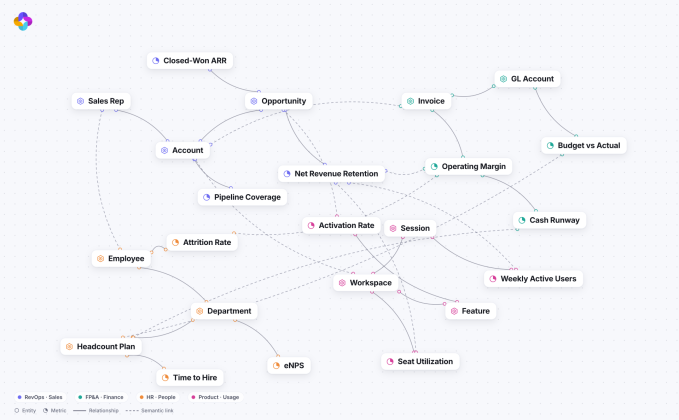
Henkin argues that Jedify’s context graph is completely different from the semantic layers, metadata catalogs, and information graphs that corporations already use as a result of it’s multi-dimensional, capturing relationships throughout entities, information, folks, permissions, and clients. It’s additionally model-agnostic and updates in actual time as info flows into and out of the methods it’s linked to.
“If you need to allow an agentic resolution to actually be autonomous, to drive selections throughout CRM information, Zendesk tickets, perhaps telemetry information that’s coming in actual time, that’s when a context graph is a lot better when it comes to capabilities versus a semantic layer,” he mentioned.
Permissions are an apparent hurdle right here. It wouldn’t do for an agent to present an intern entry to the CFO’s income projections, for instance. Henkin mentioned his platform works to handle that by inheriting permissions from identification methods, file methods, SaaS instruments, and databases, together with row-, column-, and table-level entry guidelines, then lets its clients create further teams that outline what and whom brokers or workflows are allowed to succeed in. It additionally affords observability and governance instruments to assist clients guarantee their AI brokers are behaving as meant.
Jedify is at present concentrating on mid-market and enormous enterprise clients which have mature information stacks and a number of databases or information warehouses. Henkin mentioned the corporate has between 10 and 20 early clients, one among which is The Climate Firm, and is seeing curiosity from data-heavy sectors equivalent to gaming, industrials, and client packaged items.
Snowflake’s funding and partnership are notable as a result of giant information platforms are additionally making an attempt to construct comparable capabilities. However Henkin argues that Jedify is complementary to such efforts as a result of a lot of an organization’s information, and most of its institutional information, isn’t normally saved with a single cloud supplier.
“[The large data companies] will inform you, ‘Oh yeah, simply carry all the pieces.’ However in actuality, corporations have a number of databases, and warehouses, and information options […] The massive factor is that not all your information is in these environments, and most of your information is just not there, so it’s a little bit of an obstacle that they really have,” he mentioned.
Henkin additionally famous that for corporations making an attempt to do that on their very own, coaching an AI mannequin to construct a comparable context layer might be cost-prohibitive, particularly as companies are scrutinizing and clamping down on their AI token usage.
And the fast advances in AI mannequin growth play into the corporate’s broader guess: As fashions develop extra succesful and extra interchangeable, proprietary context that helps these fashions work higher inside companies may show a worthwhile and sturdy moat.
The startup will use the contemporary money for product growth, hiring, and go-to-market movement. It brings the agency’s complete funding to about $33 million.
If you buy via hyperlinks in our articles, we may earn a small commission. This doesn’t have an effect on our editorial independence.
Source link