


‘Popa’ Botnet Linked to Publicly-Traded Israeli Agency – Krebs on Safety
For the previous 4 years, a sprawling Android-based botnet known as Popa has compelled hundreds of thousands of client TV bins to relay Web site visitors linked to promoting fraud, account takeovers, and mass data-scraping efforts. This week, researchers from a number of safety corporations concluded that the Popa botnet is linked to NetNut, a “residential proxy” supplier operated by the publicly-traded Israeli agency Alarum Applied sciences Ltd [NASDAQ: ALAR].
Malicious streaming gadgets offered on-line that enroll the person’s dwelling Web handle in a residential proxy service. Picture: HUMAN Safety.
Popa is an enormous botnet, however by all accounts it’s not like conventional botnets that enlist compromised programs in damaging actions, comparable to coordinating large distributed denial-of-service assaults. Reasonably, Popa seems designed with a singular function: Implementing a persistent communications layer able to registering a tool, sustaining long-lived encrypted connections, and opening communication tunnels on demand.
Specialists say Popa is a plugin part related to the Vo1d botnet, a large-scale malware marketing campaign focusing on unofficial Android-based TV bins. These gadgets, that are marketed below 1000’s of brand name names and mannequin numbers and broadly out there for buy at prime e-commerce locations, all promote the flexibility to stream lots of of subscription video companies for an up entrance one-time payment.
However because the FBI and safety trade consultants have warned repeatedly, these streaming bins usually bundle or come pre-installed with software that turns the person’s TV right into a “residential proxy” — permitting anybody to route their Web site visitors by way of that gadget for so long as it stays plugged right into a wall socket and related to an area community. Extra regarding, a few of these proxy networks do little to cease malicious prospects from speaking with and even compromising programs on the native community of the unsuspecting gadget proprietor.
The primary clues about Popa’s origins got here in a 2025 report from the Chinese language safety firm XLAB, which flagged at the least 9 domains that have been used to register and direct the actions of compromised gadgets. In a report launched at this time, the safety agency Qurium described the way it came upon a few of those self same domains whereas investigating a sequence of disruptive and costly information scraping occasions focusing on the corporate’s hosted organizations in Might 2026, by which the scraping exercise was scattered evenly throughout greater than 1.4 million Web addresses.
Qurium stated it discovered a number of dozen domains used to regulate Popa that have been all hosted in lockstep throughout a number of Web addresses over time, together with gmslb[.]web, safernetwork[.]io, tera-home[.]com, and ninjatech[.]io. Digging deeper, Qurium found gmslb[.]web was referenced in dozens of pirated or modded video content material streaming apps, comparable to CRICFy, DooFlix, Sprozfy, RTS Television, Flixoid, CyberFlix, Fast Streamz, TvMob and HD/OceanStreams.
Qurium’s report notes that a lot of the domains lengthy used to regulate the Popa botnet have been seized or dismantled in July 2025, after Google, HUMAN Safety and Pattern Micro teamed as much as disrupt Badbox 2.0, a botnet that’s intently related to Vo1d. Qurium stated that instantly after that disruption, a number of dozen new domains have been registered to function controllers for the Popa botnet, however that a kind of management domains was not new: ninjatech[.]io.
Ninjatech is an organization based by Moishi Kramer, whose LinkedIn profile says he’s vp of analysis and growth at NetNut. That resume credit Kramer for serving to NetNut to construct from the “floor up,” “designing the structure,” and “scaling the NetNut” earlier than the corporate was acquired by Alarum Applied sciences. A self-created itemizing on the job board F6S references Kramer as the only proprietor of the Ninjatech area (a display seize of it’s pictured under).
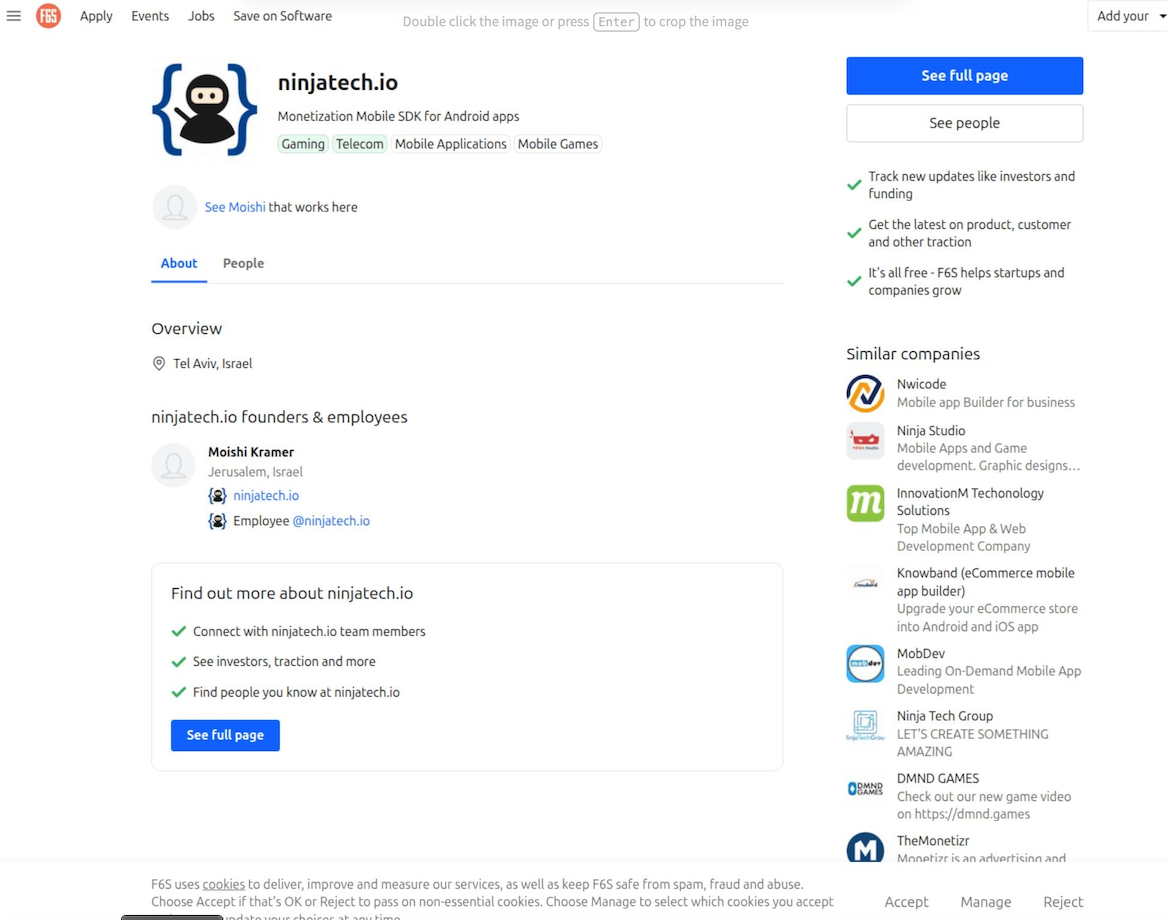
Picture: F6S.com.
Responding by way of e-mail, Mr. Kramer stated Ninjatech ceased operations roughly 5 years in the past, when the corporate offered a software program growth equipment (SDK) known as Popa that was designed to make use of a small portion of a tool’s bandwidth and to run solely after the host software obtained person consent.
“That code was offered and licensed to 3rd events together with resellers years in the past,” Kramer stated. “As soon as software program is distributed that approach, the unique developer has no management over how others later modify, rebrand, or deploy it.”
Kramer stated neither he nor NetNut builds, operates or maintains the infrastructure being described as Popa, nor does he management the Ninjatech area.
“I didn’t register the June 2025 domains you point out, and I don’t know who did,” he continued. “I’ve no management over, or visibility into, that infrastructure. I can solely inform you it isn’t operated by me or by NetNut.”
However in a separate Popa research report launched at this time, the proxy-tracking firm Synthient stated a current evaluation of the Popa SDK revealed outbound site visitors clearly related to NetNut.
“The analysis crew assesses with excessive confidence that gadgets operating Popa ahead site visitors from Netnut shoppers,” Synthient wrote. “This proves with out a shadow of a doubt that Popa actively continues for use by NetNut as a part of their proxy pool.”

Synthient’s platform receiving outbound site visitors from Popa. Picture: Synthient.com.
Alarum Applied sciences, NetNut’s Tel Aviv-based guardian firm, stated the stories by Synthient and Qurium contained “demonstrably inaccurate assertions and flawed deductions relatively than verified info.” Alarum shared an announcement saying they reject the essential characterization of the SDKs and applied sciences mentioned within the stories as a “botnet.”
“The SDKs at situation are designed to facilitate bandwidth-sharing performance and don’t rework person gadgets into malware-controlled programs or in any other case compromise the gadgets on which they function,” the assertion reads. “Netnut operates a business proxy community and maintains insurance policies, procedures, and technological measures designed to advertise lawful and accountable use of its companies.”
Alarum stated NetNut locations “important emphasis on acceptable discover and consent mechanisms, conducts buyer due diligence, displays for potential misuse, and takes steps supposed to detect and mitigate suspicious or unauthorized exercise.”
“This methodology of operation is supported each by inside procedures and insurance policies, together with performing KYC checks and extra due diligence of NetNut’s prospects, in addition to using numerous technological measures, designed to help in figuring out and addressing suspected misuse of the community,” their assertion continued.
Nevertheless, in a report launched on June 8, the proxy monitoring service Spur asserted that NetNut doesn’t require company verification or significant “know your buyer” procedures earlier than permitting prospects to buy proxy entry.
“A person can join, pay, and route site visitors by way of companion handle area, together with area belonging to establishments whose customers by no means opted in,” Spur wrote. “The ‘verified companies solely’ declare is just advertising and marketing for bandwidth sellers, not an entry management on who truly makes use of the proxies.”
“Neither is NetNut the one entrance door,” Spur continued. “A lot of downstream white labelers and resellers repackage the identical ISP proxy pool below their very own manufacturers. These shops usually carry out no KYC in any respect, much less scrutiny than NetNut itself, who on the very least would possibly assign an account supervisor to potential customers. Anybody who is aware of the place to look should purchase entry by way of a reseller with nothing greater than a burner e-mail handle and $5 in crypto.”
Synthient discovered that though the latest builds of Popa (as of three months in the past) have added the flexibility to ask the person for consent earlier than putting in proxy elements, not all variants or earlier variations of Popa comprise this performance.
“Of the over 20 real Popa publishers analyzed, none of them have been noticed asking for person consent,” Sythient wrote.
THE PREVALENCE OF POPA
Chris Formosa is senior lead info safety engineer for Black Lotus Labs, a division of the Web spine provider Lumen Applied sciences.
“What particularly makes Popa harmful is simply how broadly used NetNut is for reselling and sharing,” Formosa stated, explaining that many different proxy companies merely resell NetNut proxies relatively than constructing out their very own far-flung proxy networks. “So these Popa IPs seem in tons of various companies everywhere in the ecosystem, which makes it one of the vital problematic and harmful proxy botnets in the marketplace presently.”
Formosa stated the Popa botnet averages between 1.5 million to 2.5 million distinct IP addresses every day, counting on between 250 and 300 Web addresses which can be used to direct its actions.
“That’s why Popa is so harmful,” Formosa stated. “It is probably not the most important botnet we’ve seen, however it’s unfold everywhere in the trade, making its energy very amplified.”
Formosa stated whereas that makes Popa one of many bigger botnets on the market at this time, its numbers pale compared to these beforehand boasted by IPIDEA, a China-based proxy supplier that till not too long ago operated a every day pool of almost 10 million gadgets that they resold as proxies to anybody. In January 2026, Synthient published research displaying that a number of new massive DDoS botnets had grown quickly by tunneling by way of IPIDEA proxies into the native networks of unsuspecting TV field house owners and infecting different Android-based gadgets behind the person’s firewall.
IPIDEA is predicated largely on SDKs used to view pirated streaming content material on an enormous variety of TV field gadgets, however the service’s numbers have dwindled since January, when Google and trade companions took legal action to grab domains that IPIDEA used to regulate gadgets and proxy site visitors by way of them.
Jérôme Meyer, a safety researcher at Nokia Deepfield, stated the entire inhabitants of gadgets taking part within the Popa botnet could also be far increased than Lumen’s estimates. Meyer advised KrebsOnSecurity that Nokia is monitoring 26 of at the least 359 recognized relay nodes for the botnet, and estimates that every relay node handles between 35,000 and 60,000 shoppers concurrently.
“On the relay node subset I’m (26 of them), 750,000 distinctive sources in 24 hours,” Meyer wrote in response to questions.
Nokia Deepfield released its own report today on RoboVPN, a VPN app tied to the Vo1d botnet’s Popa plugin that Qurium attributes to NetNut/Alarum Applied sciences.
THE SYMBIOSIS OF PROXIES AND DATA SCRAPING
Specialists say most of the world’s largest proxy suppliers have up to date their public-facing branding to spotlight their utility for coaching AI platforms, implying it’s a major use case for his or her residential proxies. That’s as a result of AI companies are inclined to depend on always mass-scraping the Web for brand new textual content, pictures and video content material that can be utilized to coach massive language fashions (LLMs).
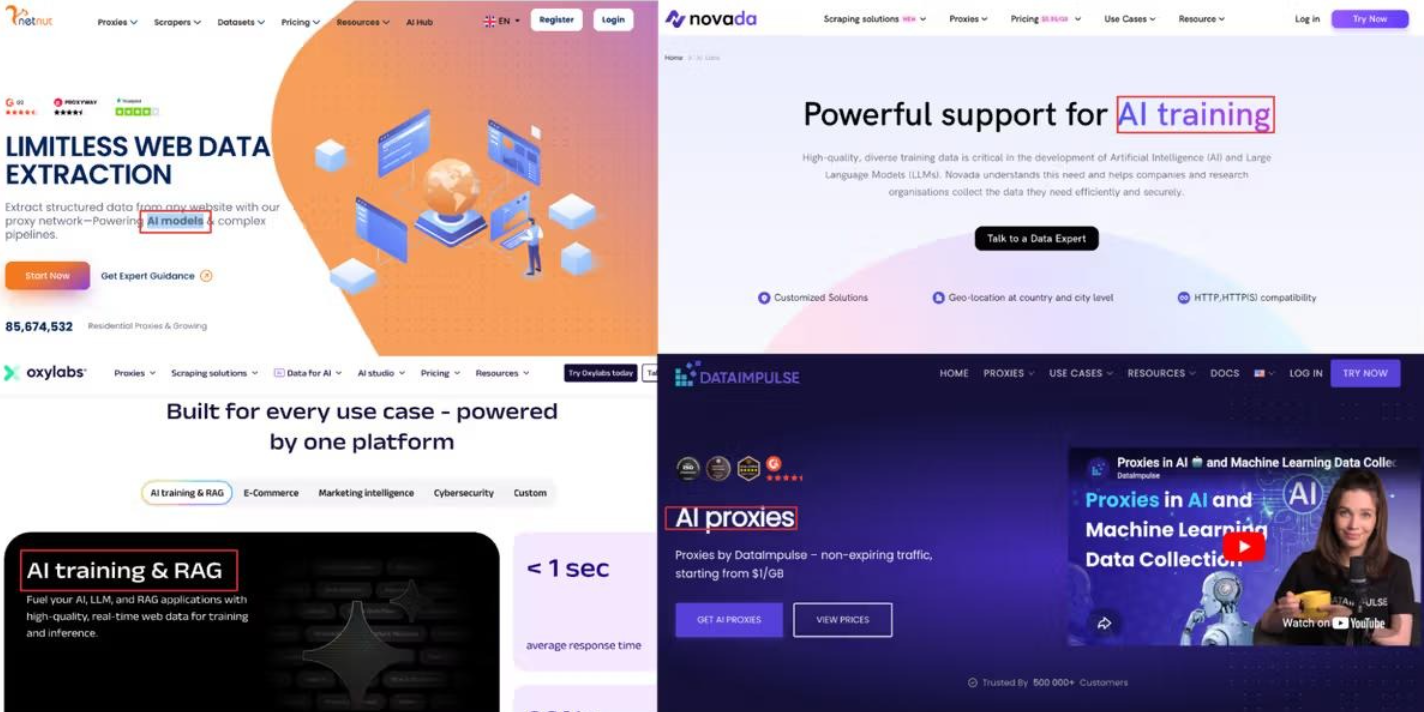
NetNut and different proxy companies have recast themselves as essential infrastructure for the AI scraping financial system. Picture: Synthient.com.
“AI firms rely on web-scraped content material: for pre-training, for retrieval, for agent grounding, for search,” reads a report this month from Embrace Safety that examines the prevalence of proxy SDKs in sensible TV apps. “However the trendy net isn’t scrapeable from a datacenter. Cloudflare, DataDome, HUMAN, amongst others throttle or block requests from recognized cloud IPs. The workaround is residential proxies. A scraping job routed by way of a Comcast or T-Cellular subscriber’s connection arrives on the goal web site from an IP that belongs to a paying residential buyer.”
This continuous content material scraping has spawned more than 70 copyright infringement lawsuits in opposition to main tech firms which have acknowledged large-scale information scraping as a serious supply of the “brains” behind their business AI choices. Sarcastically, a lot of that scraping is being aided by proxy companies which can be intimately tied to unofficial Android TV bins and related SDKs whose said function is streaming pirated content material.
The scraping exercise has change into so aggressive that it typically overwhelms the focused web sites, stopping them from being reachable by legit guests. In lots of reported instances, nonprofit organizations, libraries and universities have complained of regularly battling to maintain their companies on-line within the face of relentless data-scraping corporations hiding behind residential proxy companies.
A survey carried out final 12 months by the Confederation of Open Entry Repositories (COAR) found whereas some content material scraping bots are relatively innocuous, “others are sufficiently aggressive that they’re more and more inflicting service disruptions in repositories and different scholarly communications infrastructures.” Greater than 90 % of survey respondents indicated their repository is encountering aggressive bots, often greater than as soon as every week, and sometimes resulting in gradual downs and repair outages.
“Automated net scraping is nothing new, and has been the important thing expertise underlying serps comparable to Google for over 30 years,” wrote Brendan O’Connell, platform supervisor on the Listing of Open Entry Journals (DOAJ), a free, community-curated index of peer-reviewed educational journals. “Nevertheless, the present investor-fueled AI startup craze means there at the moment are 1000’s of well-funded firms creating and deploying their very own scraping instruments to coach AI fashions, alongside current main gamers like OpenAI and Google.”
DON’T TOUCH THAT DIAL!
Throughout the US, native communities are pushing again in opposition to the proliferation of latest information facilities aimed primarily at enhancing the capabilities of AI. However safety consultants say most people stays largely unaware that utilizing one in all these unsanctioned Android TV bins means their “sensible TV” is sort of actually utilizing a big quantity of bandwidth every month to assist practice trendy AI fashions.
Even households with out these sketchy TV bins can nonetheless have their sensible TVs was residential proxy nodes, simply by downloading one in all 1000’s of apps made out there on Samsung and LG sensible TVs. Spur stated it not too long ago scraped the LG and Samsung app shops and located that every had roughly 3,000 apps out there for obtain. Many of those apps are easy video games or utilities that state within the tremendous print that the person’s Web connection can be used to obtain information and that they’ll choose out at any time.
Spur stated it discovered that greater than 42 % of apps out there for obtain by way of the webOS working system on LG sensible TVs embody SDKs that flip one’s tv into an always-on residential proxy node. Greater than 1 / 4 of the apps made for Samsung’s Tizen working system had related residential proxy elements, Spur discovered.

Picture: Spur.us.
Specialists say it’s questionable whether or not TV apps with proxy SDKs can receive significant consent from customers for putting in an always-on proxy connection, significantly when anybody in a family — together with youngsters — can successfully choose the household TV right into a residential proxy community simply by putting in a easy sport or app.
“Privateness-policy disclosure is the improper management floor for a TV,” Embrace Safety wrote. “It’s laborious to scroll by way of a authorized doc navigated by arrow keys on a distant, and the in-app consent dialog doesn’t convey {that a} paying buyer is about to route their scraping site visitors by way of the person’s dwelling web.”
Spur’s head of analysis Sean Simmons advised KrebsOnSecurity that most individuals do not need a working psychological mannequin for what it means to promote entry to their residential IP handle, it doesn’t matter what gadget they’re utilizing.
“And on a TV, the hole is even wider,” Simmons stated. “A one-time immediate navigated with a distant can disappear into the setup circulate, whereas the app retains monetizing the connection lengthy after anybody remembers what they accepted.”
Simmons stated LG and Samsung ought to observe the lead of different TV platforms which have already drawn a line in opposition to residential proxy suppliers, pointing to insurance policies by Amazon that prohibit apps facilitating proxy companies for third events. Likewise the TV streaming gadget maker Roku reportedly now bars builders from utilizing proxy SDKs and has eliminated apps that bundled them.

Piracy associated apps pushing proxy SDKs onto unconsenting customers. Picture: Synthient.
Apps that flip one’s gadget right into a residential proxy node usually are not restricted to sensible TVs and no-name streaming bins, in fact. As famous by the safety agency Infoblox, cellular app builders can embed SDKs supplied by the residential proxy networks into their merchandise to monetize their software program, permitting them to obtain a small amount of cash on every set up.
The end result, Infoblox stated, is that gadgets are incessantly enrolled with out the proprietor’s information, usually by way of free functions comparable to VPNs, streaming apps, screensavers and “productiveness” apps comparable to PDF viewers and break reminders.
All too typically, these proxy companies are beaconing out from worker gadgets introduced into the office, Infoblox discovered. In a weblog put up earlier this month, Infoblox stated it found that absolutely 65% of its buyer base was querying a number of residential proxy associated domains.
“We noticed regular progress in these queries in 2025, with a 25% enhance over the 12 months to over 500 billion monthly,” Infoblox wrote. “Over 90% of our pharmaceutical and meals & beverage prospects have queried residential proxy indicators. Maybe much more regarding is that over 60% of presidency and banking prospects have as effectively.”
Infoblox researchers Nick Sundvall and David Brunsdon warned that with residential proxies within the company setting, exterior entry is granted to a corporation’s IP area.
“If menace actors have been to abuse the residential proxy to assault a 3rd celebration, the third celebration’s incident response would, accurately, determine your residential proxy because the supply,” they wrote. “Untangling that, by proving that you just have been the conduit and never the menace actor, prices time, creates authorized publicity, and may harm your repute. The beautiful prevalence of those companies inside buyer environments warrants consideration from each community defenders and coverage makers who ought to think about how the dangers posed by residential proxies might be impacting their safety posture.”
Source link