

Russia Hacked Routers to Steal Microsoft Workplace Tokens – Krebs on Safety
Hackers linked to Russia’s army intelligence models are utilizing recognized flaws in older Web routers to mass harvest authentication tokens from Microsoft Workplace customers, safety specialists warned right this moment. The spying marketing campaign allowed state-backed Russian hackers to quietly siphon authentication tokens from customers on greater than 18,000 networks with out deploying any malicious software program or code.
Microsoft stated in a blog post right this moment it recognized greater than 200 organizations and 5,000 client units that had been caught up in a stealthy however remarkably easy spying community constructed by a Russia-backed risk actor often known as “Forest Blizzard.”
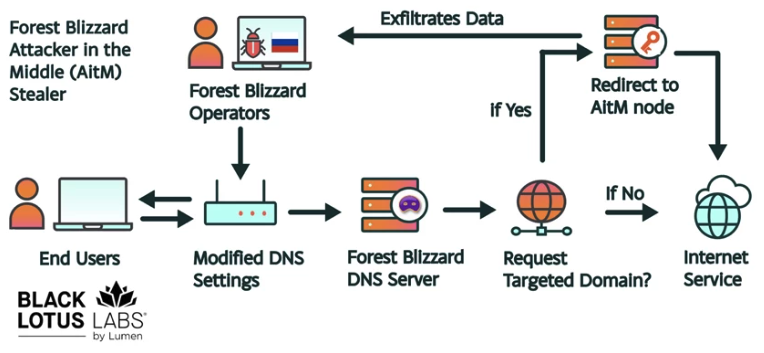
How focused DNS requests had been redirected on the router. Picture: Black Lotus Labs.
Often known as APT28 and Fancy Bear, Forest Blizzard is attributed to the army intelligence models inside Russia’s Normal Workers Important Intelligence Directorate (GRU). APT 28 famously compromised the Hillary Clinton marketing campaign, the Democratic Nationwide Committee, and the Democratic Congressional Marketing campaign Committee in 2016 in an try to intrude with the U.S. presidential election.
Researchers at Black Lotus Labs, a safety division of the Web spine supplier Lumen, discovered that on the peak of its exercise in December 2025, Forest Blizzard’s surveillance dragnet ensnared greater than 18,000 Web routers that had been largely unsupported, end-of-life routers, or else far behind on safety updates. A new report from Lumen says the hackers primarily focused authorities businesses—together with ministries of overseas affairs, regulation enforcement, and third-party electronic mail suppliers.
Black Lotus Safety Engineer Ryan English stated the GRU hackers didn’t want to put in malware on the focused routers, which had been primarily older Mikrotik and TP-Hyperlink units marketed to the Small Workplace/Residence Workplace (SOHO) market. As a substitute, they used recognized vulnerabilities to change the Area Title System (DNS) settings of the routers to incorporate DNS servers managed by the hackers.
Because the U.Ok.’s Nationwide Cyber Safety Centre (NCSC) notes in a new advisory detailing how Russian cyber actors have been compromising routers, DNS is what permits people to succeed in web sites by typing acquainted addresses, as a substitute of related IP addresses. In a DNS hijacking assault, dangerous actors intrude with this course of to covertly ship customers to malicious web sites designed to steal login particulars or different delicate info.
English stated the routers attacked by Forest Blizzard had been reconfigured to make use of DNS servers that pointed to a handful of digital non-public servers managed by the attackers. Importantly, the attackers might then propagate their malicious DNS settings to all customers on the native community, and from that time ahead intercept any OAuth authentication tokens transmitted by these customers.
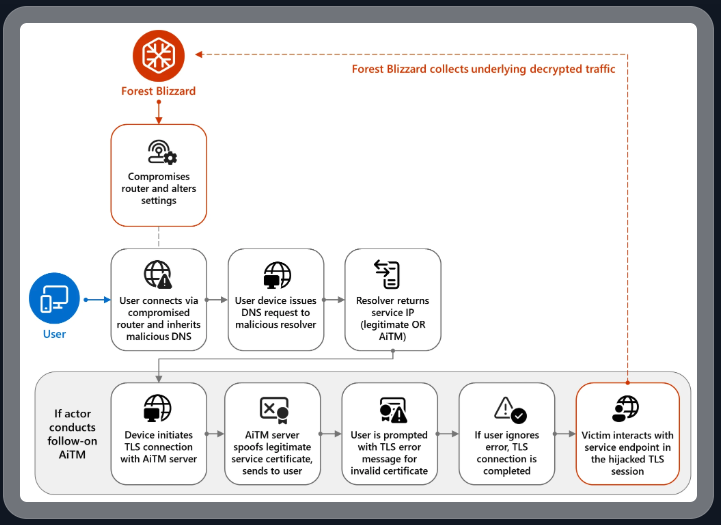
DNS hijacking by router compromise. Picture: Microsoft.
As a result of these tokens are sometimes transmitted solely after the person has efficiently logged in and gone by multi-factor authentication, the attackers might acquire direct entry to sufferer accounts with out ever having to phish every person’s credentials and/or one-time codes.
“Everyone seems to be in search of some subtle malware to drop one thing in your cell units or one thing,” English stated. “These guys didn’t use malware. They did this in an old-school, graybeard approach that isn’t actually horny nevertheless it will get the job carried out.”
Microsoft refers back to the Forest Blizzard exercise as utilizing DNS hijacking “to assist post-compromise adversary-in-the-middle (AiTM) assaults on Transport Layer Safety (TLS) connections towards Microsoft Outlook on the net domains.” The software program large stated whereas concentrating on SOHO units isn’t a brand new tactic, that is the primary time Microsoft has seen Forest Blizzard utilizing “DNS hijacking at scale to assist AiTM of TLS connections after exploiting edge units.”
Black Lotus Labs engineer Danny Adamitis stated it is going to be attention-grabbing to see how Forest Blizzard reacts to right this moment’s flurry of consideration to their espionage operation, noting that the group instantly switched up its techniques in response to a similar NCSC report (PDF) in August 2025. On the time, Forest Blizzard was utilizing malware to regulate a much more focused and smaller group of compromised routers. However Adamitis stated the day after the NCSC report, the group shortly ditched the malware method in favor of mass-altering the DNS settings on hundreds of weak routers.
“Earlier than the final NCSC report got here out they used this functionality in very restricted cases,” Adamitis instructed KrebsOnSecurity. “After the report was launched they carried out the aptitude in a extra systemic trend and used it to focus on every little thing that was weak.”
TP-Hyperlink was among the many router makers facing a complete ban in america. However on March 23, the U.S. Federal Communications Commission (FCC) took a much wider method, announcing it could not certify consumer-grade Web routers which might be produced exterior of america.
The FCC warned that foreign-made routers had turn out to be an untenable nationwide safety risk, and that poorly-secured routers current “a extreme cybersecurity threat that may very well be leveraged to right away and severely disrupt U.S. crucial infrastructure and immediately hurt U.S. individuals.”
Consultants have countered that few new consumer-grade routers could be accessible for buy below this new FCC coverage (in addition to perhaps Musk’s Starlink satellite tv for pc Web routers, that are produced in Texas). The FCC says router makers can apply for a particular “conditional approval” from the Division of Warfare or Division of Homeland Safety, and that the brand new coverage doesn’t have an effect on any previously-purchased consumer-grade routers.
Source link