
Satya Nadella has issued a surprising warning to firms utilizing AI
Of all of the debates raging concerning the potential downsides of AI, there may be one fear inflicting essentially the most hand-wringing amongst AI lovers in Silicon Valley. Their concern is that the enormous AI labs that promote proprietary fashions are in some way appearing like Trojan horses.
The priority is that, as startups and enterprises use AI fashions from labs like OpenAI and Anthropic, the labs acquire ever-increasing entry to these firms’ most delicate enterprise info. The mannequin makers can then use that data for themselves, doubtlessly changing into opponents to their very own prospects. These issuing such warnings vary from VCs like Jason Calacanis to Palantir CEO Alex Karp.
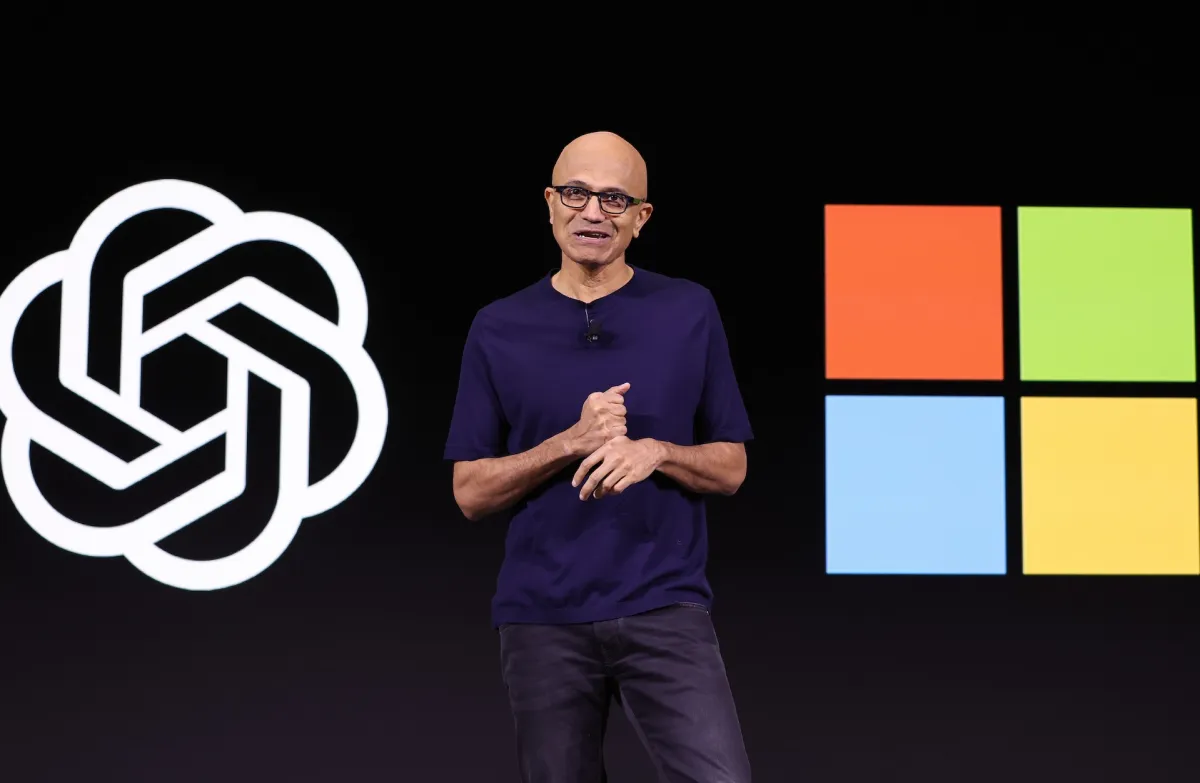
Now, in a stunning blog post printed on Sunday, Microsoft CEO Satya Nadella has joined this crowd. Nadella warns that AI customers (the “consumers” as he calls them) are paying twice. They knowingly spend for AI token utilization however additionally they, obliviously, hand over invaluable information within the course of.
“You primarily pay for intelligence twice, as soon as with cash, and once more with one thing much more invaluable: the proprietary data you should disclose to make that intelligence helpful. The higher you need the mannequin to carry out, the extra of that data it’s a must to feed it!” he writes.
Most dangerously, enterprises are actually instructing the fashions concerning the nuances of their companies, he argues.
“Fashions study from ‘exhaust,’ the prompts folks write, the instruments brokers use, and particularly the corrections folks make when the mannequin is incorrect. Each correction is distilled into institutional know-how,” he writes.
That is “the type of data a competitor may by no means purchase,” and but enterprises are handing it over.
Nadella argues that if AI firms get to freely scrape the web to coach their fashions, it’s solely honest that enterprises get to review — or “distill” — these fashions in return. “Distillation” is the follow of utilizing a mannequin’s personal outputs to study the way it works and to coach a brand new, usually cheaper, mannequin based mostly on these insights. In February, Anthropic accused Chinese language open supply fashions of sending millions of prompts to Claude as a approach to enhance their very own fashions, and urged the U.S. authorities crack down on export controls.
Nadella’s level is that mannequin makers can’t have it each methods. It’s hypocritical for them to freely prepare on the world’s information whereas proscribing others from doing the identical to their fashions.
“Whereas the nice innovation that comes from mannequin suppliers having honest use rights to coach fashions on public information is required, I discover it ironic that the established order is to then flip round and impose restrictive phrases on distillation,” Nadella writes.
Nadella is especially involved when mannequin makers “reserve the proper to study from buyer utilization and interplay information.”
Nadella’s answer is the type of factor the CEO of an enormous cloud supplier would counsel. He desires firms to “retain possession” of their information, together with prompts, suggestions, and so on. So he’s urging them to construct their very own “proprietary studying environments” on the cloud (the place their information is probably going already saved anyway and, conveniently, may imply Microsoft’s cloud, Azure). He additionally desires firms to construct in what he calls “orchestration layers” — primarily, a technique to simply swap between AI fashions from totally different suppliers slightly than being locked into one. Instruments like AI “gateways” that allow firms do precisely this have develop into more and more common.
Whereas Nadella by no means makes use of the phrases “open supply” as the tactic for retaining possession, that is an apparent subtext. But, there’s one other subtext.
Giant firms, lots of which nonetheless have a few of their very own information facilities along with utilizing the cloud, are already shifting to open supply fashions put in on their very own premises (“on-prem,” in business jargon). Idit Levine, founder and CEO of Solo.io — which makes networking and safety software program that helps enterprises handle AI programs — says she’s seeing precisely this shift play out together with her personal prospects. After experimenting with proprietary mannequin makers, they begin asking themselves: “Can I take an open supply mannequin and run it on-prem? It should do nearly 90% of what the large one’s doing. It should price approach much less,” she tells TechCrunch. “They perceive that, they usually can management it.”
Solo.io’s expertise was chosen final yr to be the tech powering the Linux Foundation’s Agentgateway project. Her firm counts enterprises like T-Cellular, ADP, and SAP as prospects. She sees firms more and more putting in on-premise open supply fashions and sees it as the subsequent massive wave in enterprise AI use.
She’s not alone. Vercel (finest often known as a platform for constructing and internet hosting web sites, which has not too long ago added AI model-switching instruments) and OpenRouter (an organization that helps builders route requests throughout totally different AI fashions) are each seeing a surge in visitors to open source models. The truth is, open fashions accounted for 29% of all visitors routed through Vercel’s gateway final month.
With the CEO of Microsoft, an organization that has invested in each OpenAI and Anthropic, now brazenly urging enterprises to be cautious of utilizing proprietary fashions, we’ll guess this pattern continues to develop. “In consuming intelligence, you’re creating intelligence. And what you create ought to belong to you,” Nadella writes.
Whenever you buy via hyperlinks in our articles, we may earn a small commission. This doesn’t have an effect on our editorial independence.
Source link